

Helping Families and Workplaces Resolve Disputes Peacefully Across Ontario
Ethics, Complexity, and Professional Sustainability
Med-Arb involves more than process management and decision-making. It also requires continuous attention to ethics, participant confidence, emotional regulation, procedural legitimacy, and the long-term sustainability of professional practice.
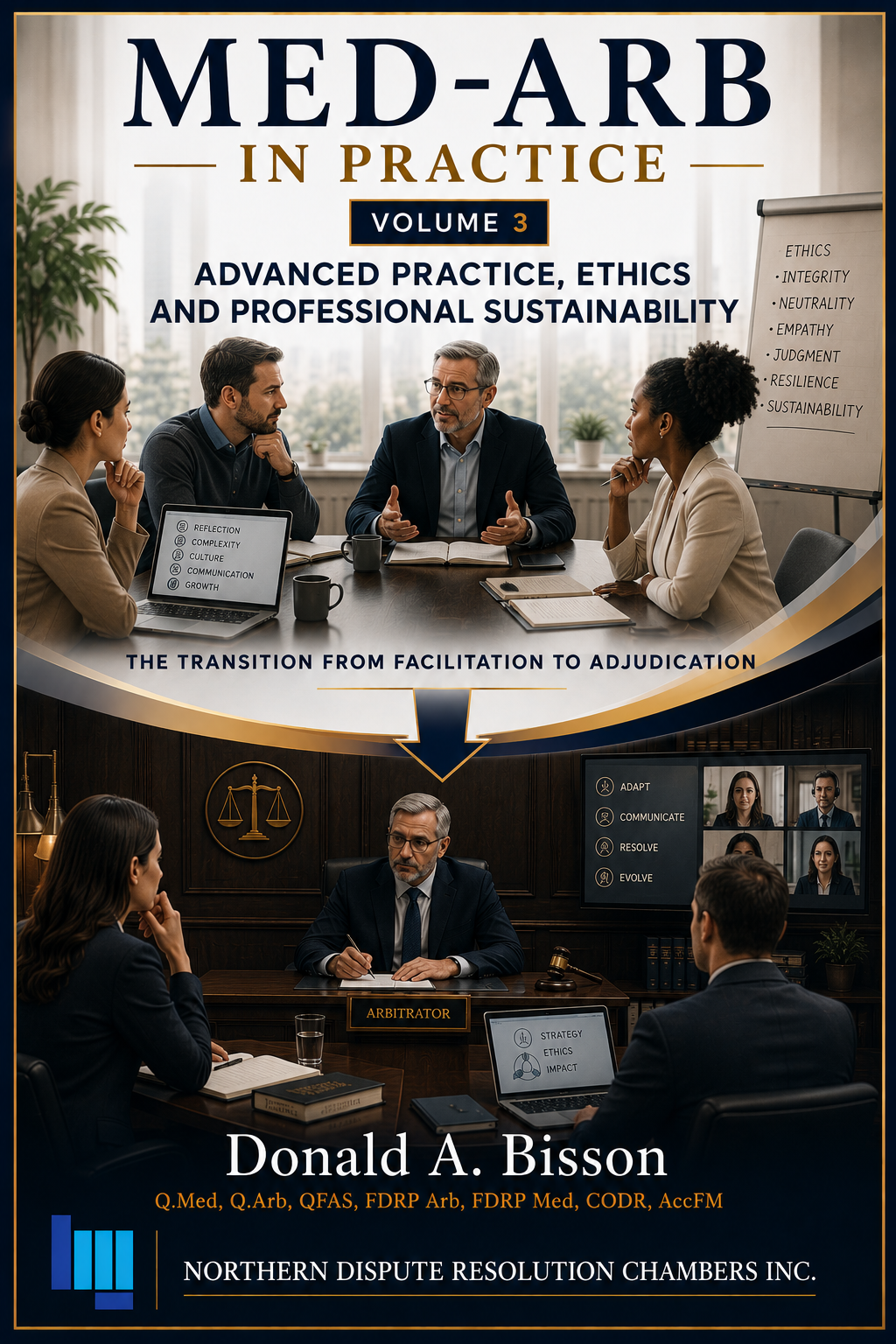
Med-Arb in Practice — Volume 3 explores the complex ethical, procedural, and human challenges that arise within Med-Arb practice, particularly when disputes become emotionally charged, procedurally difficult, or professionally sensitive.
Rather than viewing Med-Arb as a purely technical process, this volume emphasizes the importance of reflective practice, professional judgment, neutrality awareness, and maintaining confidence in the integrity of the process under difficult conditions. Practitioners are guided through complex scenarios involving difficult behaviour, procedural breakdowns, ethical concerns, termination decisions, legitimacy challenges, and professional stress management.
This practical approach helps practitioners navigate complexity while maintaining fairness, professionalism, and confidence in the Med-Arb process.
The most difficult challenges in Med-Arb often arise not from procedure alone, but from the human realities surrounding conflict, perception, fairness, trust, and professional judgment.
A technically correct process may still fail if participants lose confidence in the neutrality, fairness, or legitimacy of the process itself. The practitioner must therefore remain continuously attentive to ethics, communication, emotional regulation, and reflective decision-making throughout the dispute resolution process.
This volume focuses on the professional maturity, ethical awareness, and practical judgment required to sustain effective Med-Arb practice over time.
This book is intended for educational and professional development purposes. It does not provide legal advice and should not be relied upon as a substitute for legal training, jurisdiction-specific rules, or independent legal advice. Practitioners should work within their professional competence, applicable legislation, ethical obligations, and any governing standards that apply to their practice.
Donald A. Bisson is a mediator, arbitrator, educator, and course developer with extensive experience in dispute resolution, professional training, and structured process design. His work focuses on practical frameworks, procedural clarity, and helping practitioners apply professional judgment in real-world conflict settings. Through Northern Dispute Resolution Chambers Inc., he develops resources and training for mediators, arbitrators, and professionals seeking clear, structured approaches to dispute resolution practice.
eBook / PDF - Direct from Author @ $10 CAD Discount
Kindle Google Book Soft Cover Book